Wallaby: The Modern Calligraphy Font That Brings Handcrafted Elegance to Digital Design
Typography is often the unsung hero of great design. When a font feels just right — not too stiff, not too whimsical — it can elevate an entire project. Enter Wallaby, a modern calligraphy font that has been made completely by hand. This isn’t another mass-produced, algorithm-smoothed typeface. Wallaby carries the warmth, irregularity, and personality of real brush or pen work, while fitting neatly into today’s digital workflows. For designers, brand managers, and anyone who works with words, understanding what Wallaby offers — and where it shines — can open up new creative possibilities.
What Makes Wallaby Stand Out in a Crowded Font Market
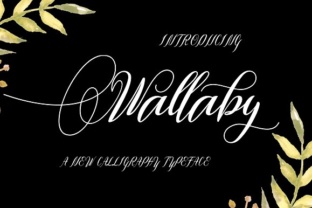
There is no shortage of calligraphy fonts available online. Many are traced, auto-traced, or heavily edited to achieve a uniform look. Wallaby takes a different route. Every single letterform was drawn by hand from scratch. That means each curve, each loop, each subtle variation in stroke weight was guided by a human hand, not a vector algorithm. The result is a font that breathes. You will notice slight inconsistencies in the swashes, the way letters connect, and the natural taper of strokes — and that is precisely the point.
In an era where brands often chase hyper-perfection, a handcrafted font like Wallaby introduces a dose of authenticity. It recalls the feeling of a handwritten note or a bespoke invitation. Yet it remains thoroughly modern: clean enough for contemporary layouts, expressive enough to hold attention. This balance is hard to achieve. Many handwritten fonts tip too far into messy or decorative territory, making them unusable for body text or serious branding. Wallaby walks the line with careful intention.
Key Characteristics of the Wallaby Typeface
- Natural stroke variation — Thick and thin transitions that mimic a flexible nib or brush.
- Organic letter connections — Not all letters link the same way, giving a true hand-lettered rhythm.
- Generous ascenders and descenders — Adds elegance and airiness to lines of text.
- Swash alternatives and ligatures — Allows for customisation without breaking the flow.
- Legibility at medium sizes — While calligraphic, Wallaby remains readable for short paragraphs, headlines, and quotes.
These qualities make it especially appealing for projects where you want the text to feel personal, yet polished. It is not the font you choose for a 10,000-word whitepaper — but for a brand tagline, an invitation header, or a product label, it can be transformative.
Where Wallaby Fits in Modern Design Workflows
Designers today work across both digital and print mediums. A font like Wallaby needs to perform well in web browsers, in mobile apps, on social media graphics, and on physical packaging. Because it was created with careful attention to metrics and spacing, it handles these environments gracefully. The OpenType features — including stylistic alternates and contextual ligatures — give designers control over the final look. You can activate swashes for a more ornate feel, or use the default forms for a cleaner appearance.
Consider a wedding invitation suite. The main headline in Wallaby instantly conveys romance and craftsmanship. Pair it with a clean sans-serif for the details, and the contrast works beautifully. For a coffee brand that wants to highlight artisanal roasting, Wallaby on the bag label can suggest attention to craft. In a digital context, a landing page for a creative agency might use Wallaby for its hero heading, then rely on a neutral system font for body text. The hand-drawn quality signals that the agency values creativity over corporate rigidity.
Practical Scenarios Where Wallaby Excels
- Brand identity — Logos, visual identities, and wordmarks that need a human touch.
- Social media graphics — Instagram posts, Pinterest pins, and quote cards where typography is the focal point.
- Printed stationery — Business cards, letterheads, thank-you cards, and packaging inserts.
- Ebook covers and headers — Adding character to chapter titles or section breaks.
- Signage and quotes — Wall displays, cafe chalkboards, or inspirational wall art.
Each of these use cases benefits from the font’s handcrafted personality. The key is to let Wallaby lead — do not crowd it with competing decorative elements. Give it whitespace, and it will reward you with presence.
Practical Benefits of Choosing a Handmade Calligraphy Font
Why go through the trouble of selecting a hand-drawn font when standard scripts are readily available? The answer lies in differentiation. Audiences are visually savvy. They can tell when a typeface feels generic. Wallaby introduces a level of nuance that is difficult to fake. The subtle irregularities — a slightly longer descender here, a looser loop there — create a pattern that the eye experiences as natural, not robotic.
From a technical standpoint, modern calligraphy fonts like Wallaby are built with careful hinting and kerning. That means they display consistently across operating systems and browsers, something that wasn’t always true for earlier handwritten fonts. Designers no longer have to worry about a swash clipping in Safari or a ligature breaking in Chrome. The font file has been optimised for real-world use.
Another advantage is emotional impact. Studies in typography psychology suggest that handwritten styles increase perceived sincerity and warmth. For brands targeting wellness, creativity, or premium handmade products, Wallaby can be a strategic choice. It says “someone cared enough to draw this,” even when the layout is entirely digital.
Considerations Before Using Wallaby in a Project
No font is perfect for every situation, and Wallaby is no exception. Its calligraphic nature means it works best at display sizes — typically 24 points and above. Using it for long body text fatigue the eye, especially on screens. The generous stroke contrast can create readability issues at small sizes. For that reason, pair Wallaby with a legible sans-serif or serif for secondary text. Simple pairings like Wallaby + Montserrat or Wallaby + Open Sans keep the design balanced without competing for attention.
Also consider the audience. A handwritten font might feel too informal for legal documents, corporate reports, or medical communications. But for lifestyle blogs, wedding websites, boutique ecommerce, and personal branding, it fits naturally. Think about the context: if you are designing for a high-end law firm, Wallaby is probably not the right choice. If you are designing for a floral studio, it might be perfect.
Licensing is another factor. Wallaby is typically offered with standard desktop and web licenses. Check the specific terms for embedding in apps, ebooks, or commercial products. Many foundries allow modifications for logos, but always verify. The investment in a quality handcrafted font pays off when you know you have clear usage rights.
How Wallaby Fits Into the Broader Typography Landscape
The rise of handcrafted fonts is part of a larger movement toward authenticity in design. Minimalism dominated the 2010s, but the 2020s have seen a resurgence of decorative and expressive typography. Brands want to stand out, and generic fonts no longer cut it. Wallaby answers this need by offering a distinct voice without being cartoonish or unreadable.
In the context of calligraphy fonts, Wallaby sits between casual scripts and formal copperplate styles. It is more structured than a messy brush font, but more relaxed than a traditional pointed pen script. This middle ground is surprisingly versatile. You can use it for both vintage-inspired designs and modern minimalist layouts, depending on colors and supporting elements.
For those who work with variable fonts and advanced OpenType features, Wallaby offers a taste of that sophistication in a more traditional package. While it is not a variable font, its multiple alternates per character allow for dynamic typography on static layouts. Designers can manually select swash variants in software like Illustrator or InDesign, or rely on contextual alternates that automatically apply in supported apps.
Tips for Getting the Most Out of Wallaby
- Keep line spacing generous — Ascenders and descenders need room to breathe.
- Avoid heavy justification — Ragged right margins preserve the natural flow.
- Use colour intentionally — A muted palette lets the font’s details shine.
- Experiment with letter spacing — Slight tracking adjustments can make Wallaby feel more airy or more connected.
- Test at actual size — A headline that looks good at 300% zoom might feel overwhelming at real scale.
These small decisions can make the difference between a design that feels cohesive and one where the font fights with the layout. Wallaby rewards thoughtful treatment.
Final Observations on Wallaby and Its Place in Your Toolkit
Choosing a font is rarely a neutral decision. Every typeface carries associations, moods, and limitations. Wallaby, with its hand-drawn roots and modern finish, offers a specific kind of warmth that more mechanical fonts cannot replicate. It is not a universal solution, but it does not claim to be. For projects where the message needs to feel personal, crafted, and approachable, Wallaby delivers.
Whether you are designing a brand identity, packaging a product, building a website, or creating social media assets, consider where a handcrafted touch might make the difference. Wallaby is a tool, but it is also an expression of care. In a world of automated everything, that still matters.
If you are looking for a modern calligraphy font that has been made completely by hand and can handle real design challenges with grace, Wallaby is worth a close look. Download the trial, test it on a few projects, and see how it transforms your typography. You might find that the best tool for the job is one that feels like it was made by someone, not just generated by code.