Firdaus: A Handmade Calligraphy Font Built for Real Design Work
Typography decisions often come down to a trade-off between character and clarity. Many designers have experienced the frustration of finding a font that looks stunning in a promotional sample but breaks apart in everyday use—missing glyphs, inconsistent stroke weights, or spacing that requires hours of manual adjustment. Firdaus avoids that pattern. This fresh, handmade font with a calligraphy style offers something rarer than novelty: practical versatility wrapped in an expressive, handcrafted finish.
Firdaus does not try to be all things to all users. It is not a neutral workhorse typeface for body text, nor does it attempt to mimic a rigid formal script. Instead, it occupies a specific, useful middle ground. The letterforms carry the natural variation of hand-drawn strokes while maintaining enough structure to remain legible and predictable across different sizes and contexts. That balance is what makes Firdaus worth examining for anyone who works with visual communication.
What Firdaus Brings to the Table
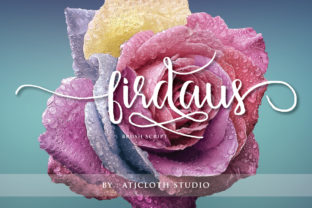
At its core, Firdaus is a handmade calligraphy font. Each character carries the subtle irregularities that come from actual hand-drawn lettering—slight shifts in angle, gentle changes in stroke thickness, and a rhythm that feels organic rather than mechanically repeated. These are not flaws; they are the qualities that give the font its warmth and visual interest.
What sets Firdaus apart from many other script-style fonts is its restraint. The calligraphy influence is clear, but the letterforms do not lean into the elaborate flourishes that often make handwritten fonts difficult to use in practical layouts. The ascenders and descenders are kept under control. The connecting strokes, where present, flow naturally without forcing awkward joins between every pair of letters. This makes Firdaus suitable for situations where a font needs to feel personal and crafted without sacrificing readability.
The font works well across a moderate range of sizes. At display sizes above 36 points, the hand-drawn details become visible and add texture to headings, titles, and short phrases. At smaller sizes for subheadings or short callouts, the letterforms hold together without losing their character. The sweet spot for most uses falls between 18 and 48 points, where the handmade quality remains apparent without overwhelming the layout.
Strengths That Matter in Real Projects
One of the first things a designer notices when working with Firdaus is how the font handles across different applications. The glyph set includes uppercase and lowercase letters, numerals, and essential punctuation. Basic diacritical marks are present, which broadens its usefulness for projects that require accented characters. The spacing is consistent enough that most words set in Firdaus look balanced without manual kerning, though adjustments between certain letter pairs are sometimes beneficial for polished work.
The stroke contrast is moderate, not extreme. This means Firdaus reproduces well across various output methods—digital screens, inkjet and laser printers, and even larger format printing. The thinner strokes do not disappear at smaller sizes, and the thicker strokes do not overwhelm the overall letter shape. This reliability in reproduction is a practical advantage for anyone who needs a font that performs consistently across different media.
Another strength worth noting is the font's flexibility across visual styles. Firdaus pairs naturally with clean sans-serif typefaces for a contrasting but harmonious combination. It also works alongside simple serif fonts in layouts that require a blend of traditional and contemporary elements. The key is restraint. Overusing any script or calligraphy font in a single design creates visual noise, but Firdaus used selectively—for a heading, a pull quote, or a branding element—adds focus without clutter.
Practical Applications Across Common Use Cases
Firdaus fits naturally into several common design scenarios. Brand identity work is one of the most obvious applications. Small businesses, creative professionals, and boutique service providers often need a logo or wordmark that feels personal without looking amateurish. Firdaus provides that handcrafted quality without the inconsistency or poor spacing that undermines many free handwritten fonts.
Social media graphics benefit from Firdaus as well. Short text overlays, quote cards, and title frames gain a human quality that contrasts well with the polished, often sterile look of platform-native templates. The font stands out in feeds dominated by generic sans-serif typefaces, which helps with engagement from users who respond to visual authenticity.
Printed materials such as greeting cards, invitations, product packaging, and small signage are another strong fit. The handmade quality aligns naturally with physical products where a personal touch adds perceived value. A wedding invitation, a branding card for an artisan food product, or a thank-you note included with an online order all gain from Firdaus's balance of warmth and legibility.
Blog and website headings are a less obvious but equally useful application. Many content creators and small publishers rely on platform themes that offer limited typographic choices. Adding Firdaus as a heading font through custom CSS or a font plugin immediately distinguishes a site from the thousands of blogs using the same default typefaces. The key is using it sparingly—reserving Firdaus for primary headings or featured content rather than applying it across every level of the page hierarchy.
Who Benefits Most from Firdaus
Freelance designers and creative professionals working with small to medium clients will find Firdaus a practical addition to their font library. It covers a specific niche that many all-purpose script fonts miss—handmade without being messy, personal without being unreadable. For designers who regularly produce brand identities, social content, or print materials for clients who want a human touch, Firdaus offers a reliable option that does not require hours of manual tuning.
Small business owners and entrepreneurs managing their own marketing materials also stand to gain. Learning typography fundamentals takes time, and choosing a font with built-in balance and readability reduces the risk of amateur-looking results. Firdaus is forgiving enough for non-designers to use effectively while remaining polished enough for professional contexts.
Bloggers, content creators, and publishers who handle their own visual branding will appreciate the font's versatility across digital formats. A consistent heading style built around Firdaus can unify a blog, a YouTube channel, and social media profiles without requiring custom design work for each platform.
Educators creating worksheets, classroom materials, or educational content aimed at younger students may also find value. The hand-drawn quality feels approachable and less formal than standard textbook fonts, which can improve engagement in learning materials. Legibility remains adequate at appropriate sizes, though teachers should test readability for their specific use case before committing to large text blocks.
Realistic Limitations and Considerations
No font works for every situation, and Firdaus has limitations that users should understand before committing to it. Like all calligraphy-style fonts, it is not suitable for extended body text. Paragraphs of dense copy set in Firdaus quickly become tiring to read. The irregular stroke patterns that make the font appealing in short bursts create visual fatigue when scaled up to long articles or reports. Reserve Firdaus for headings, short phrases, and accent text.
Users should also test the font across their specific output methods before finalizing a project. While Firdaus reproduces well in most standard conditions, very small sizes below 14 points may cause the finer strokes to become indistinct, especially on lower-resolution screens or in print with poor registration. This is not unusual for handwritten or calligraphy-style fonts, but it is worth verifying for projects that require small text elements.
The glyph set, while adequate for most English-language projects, is not extensive. Users working with multiple languages or specialized typographic needs should review the character coverage carefully before purchasing or licensing. Missing punctuation, uncommon ligatures, or limited currency symbols may require fallback fonts or additional design work.
Evaluating Long-Term Value
A font's value is only partially determined by its initial quality. How well it holds up across repeated use, different projects, and evolving design trends matters more than first impressions. Firdaus has characteristics that suggest reasonable longevity. Its handmade quality is grounded in traditional calligraphy rather than passing stylistic fads. The restrained approach to flourishes and connections means it will not look dated in a few years the way more exaggerated script fonts often do.
The font also scores well on the usability scale. Standard licensing terms for Firdaus typically allow for web use, print, and commercial projects without complex restrictions, which is important for professionals who need clarity about where and how they can deploy the font. Users should always verify the specific license agreement for their purchase, as terms vary between foundries and distributors.
From a workflow perspective, Firdaus integrates cleanly into standard design tools. File formats common to modern design work—OTF, TTF, WOFF, and WOFF2—are generally available, covering desktop and web applications. The installation process is standard, and the font name is clear enough to find quickly in long font menus.
Practical Recommendations for Getting the Most Out of Firdaus
Start by testing Firdaus in the actual contexts where you plan to use it. Load it into your design software, set sample text at various sizes, and evaluate how it looks on the screens and output devices your audience will encounter. Pay particular attention to spacing between certain letter combinations—pairs like "Va," "To," and "We" often benefit from manual kerning adjustments, as do any combinations where a curved letter meets a straight one.
Pair Firdaus with a clean, neutral typeface for body text. A simple sans-serif such as Open Sans, Lato, or Inter works well because it contrasts with the handmade quality of Firdaus without competing for attention. Keep the hierarchy clear: Firdaus for the main heading or featured element, and the secondary font for supporting text, captions, and body copy.
Avoid mixing Firdaus with other script or calligraphy fonts in the same layout. Multiple handwritten styles in a single design create visual chaos. If you need variety within a heading system, use different weights or sizes of Firdaus itself rather than introducing a second decorative typeface.
For web use, implement Firdaus as a web font with proper fallback options. Specify a generic cursive or script font as the secondary choice, but also include a readable sans-serif as a third fallback for users on systems that may not render script fonts reliably. This ensures your content remains accessible even if the font fails to load.
Final Considerations for Potential Users
Firdaus succeeds because it does not overpromise. It is a handmade calligraphy font built for specific, practical uses within a broader typographic system. Designers who approach it with clear expectations—using it for accent text, headings, branding elements, and short-form content—will find it a reliable and visually appealing tool. Users who expect a single font to handle everything from headlines to footnotes will be disappointed, but that is not a limitation unique to Firdaus; it is a reality of how expressive typefaces work.
For the right audience, Firdaus fills a genuine gap. It offers the authenticity of hand-drawn lettering without the unpredictability of raw handwriting fonts. It provides calligraphy-style warmth without the ornate complexity that limits usability. In a market crowded with generic scripts on one side and overly decorative display fonts on the other, Firdaus occupies a practical middle ground that many designers and content creators will find genuinely useful.