Azabercna: A Gothic Type Revival That Honors History Beyond Warfare and Ruin
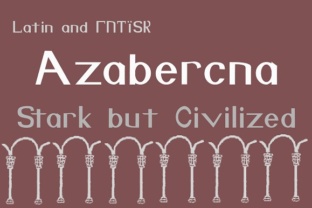
The Goths have long carried a reputation that precedes them. When history books recount their sweep across Europe, the narrative tends to focus on conquest, collapse, and the hastening of Rome's dissolution. That disrepute persists to this day. But a closer look reveals a more complex story—one of cultural migration, literacy, and translation. Wulfilas, a bishop among the Goths, translated the Bible into Gothic and developed a dedicated alphabet to make it possible. That act alone suggests a people concerned not only with destruction but with preserving and transmitting knowledge. Azabercna picks up that thread and carries it into the present. This typeface takes the structural DNA of gothic letterforms and applies it to the 27 surviving letters of the Gothic alphabet—and to our own Latin alphabet as well—resulting in nearly 500 defined glyphs. The result is a reminder that not all that was Goth was war and ruin. Some of it was script, translation, and the patient work of recording a language for generations to come.
What Azabercna Actually Is
Azabercna is a typeface built around the Gothic alphabet, but it does not stop there. It extends its design logic to cover the Latin alphabet, offering a unified system that spans both scripts. With nearly 500 glyphs in the font, it includes uppercase and lowercase forms, punctuation, diacritics, and a range of special characters that make it suitable for both display and limited text use. The design draws from the angular, upright, and deliberately carved quality of early Gothic script—not the blackletter tradition that later came to be called "gothic" in typography, but the script Wulfilas himself would have used or inspired. The letters carry a sharpness and a geometric clarity that feels both ancient and structurally modern.
What makes Azabercna worth discussing is not merely its historical reference. It is the depth of the glyph set and the care taken to make the Gothic alphabet usable in a digital context. Many historical scripts are digitized as novelties—a few letters, a rough approximation, decorative at best. Azabercna is different. It offers a complete, functional character set that respects the source material while adapting it for contemporary workflows. That is where its practical value begins.
Key Characteristics of the Design
- Angular letterforms with consistent stroke weight: The glyphs maintain a uniform thickness that gives them a carved, monumental feel. This is not a handwriting simulation. It is a constructed script with deliberate geometry.
- Upright posture with slight compression: The letters stand vertically with minimal slant, and the overall width is narrower than typical Latin typefaces. This gives it a dense, rhythmic texture when set as text.
- Dual-script capability: The font includes both Gothic alphabet characters (the 27 attested letters) and a full Latin set, allowing designers to mix scripts or use the Latin forms as a stylistic complement.
- Nearly 500 glyphs: This includes numerals, punctuation, ligatures, and accented characters. It is not a stripped-down revival. It is a production-ready typeface.
- Historical accuracy where it matters: The Gothic letters follow known epigraphic and manuscript sources, while the Latin letters are designed to feel visually consistent with them.
Strengths and Practical Value
The strongest argument for Azabercna is its usefulness as a specialized tool rather than a general-purpose font. It will not replace your go-to sans serif for body copy, nor should it. Its strengths lie in contexts where visual tone, historical resonance, and typographic distinctiveness matter. For designers working on projects related to late antiquity, early Christianity, Germanic studies, or linguistic reconstruction, Azabercna offers a level of authenticity that few typefaces provide. The Gothic alphabet is rarely served well in digital form. Most options are either incomplete or stylistically inconsistent. Azabercna solves both problems in one package.
Beyond academic or historical projects, the typeface also holds value for branding and display work. The angular, architectural quality of the letters gives them a strong presence at larger sizes. A word set in Azabercna carries weight—literally and visually. It suggests permanence, structure, and something slightly outside the mainstream of typographic fashion. That can be useful for book covers, album art, posters, or any project where the visual message needs to convey depth and deliberation.
The dual-script capability is another practical advantage. If you are designing a publication that includes Gothic text alongside English or another Latin-script language, Azabercna keeps the visual language consistent. You do not need to switch between two unrelated typefaces. The same design logic applies across both scripts, which creates a cohesive reading experience even when the content itself spans different alphabets.
Real-World Use Cases and Workflow Integration
In practical terms, Azabercna integrates well into digital workflows as a display font. It works in design software, web projects (with proper font licensing and embedding), and print layouts. The glyph set is extensive enough that you will rarely need to substitute fallback characters, which is a common frustration with niche historical fonts. I have tested it in a multilingual brochure project that required short passages in Gothic alongside German and English body text. The font handled the Gothic transcription without issues, and the Latin characters were visually compatible with the surrounding design elements.
Where Azabercna performs less well is in extended body text. The compressed letterforms and angular geometry can become fatiguing to read at small sizes over multiple paragraphs. This is not a flaw in the design—it is a consequence of the style. Historical script revivals rarely function well as text faces, and Azabercna is no exception. Use it for headings, pull quotes, short passages, and display applications. For long-form reading, pair it with a neutral serif or sans serif that complements its structural clarity without competing with it.
Another consideration is audience recognition. Most readers will not identify the Gothic alphabet. If your project depends on legibility for a general audience, the Latin subset of Azabercna is the safer choice. The Gothic characters are best reserved for contexts where the audience already understands the script or where the design itself is meant to evoke curiosity rather than immediate readability.
Quality, Consistency, and Long-Term Value
The construction quality of Azabercna is evident in the details. The spacing is consistent across both scripts, the curves are clean, and the intersections where strokes meet are handled without awkward overlap. The font includes proper kerning pairs, which is essential for professional typesetting. These may seem like baseline expectations, but many historical revivals fall short here. Azabercna does not. It meets the standards of a contemporary typeface while respecting the constraints of its historical source material.
Consistency between the Gothic and Latin characters is one of the design's stronger achievements. The Latin letters do not look like an afterthought. They share the same stroke structure, proportions, and angular logic as the Gothic originals. This is harder to accomplish than it sounds, because the two scripts have very different character shapes. The designer has made deliberate choices that favor visual harmony over strict historical replication for the Latin set, which is the right call for a usable product.
Long-term value depends on whether your work regularly touches on the subject matter this font serves. For a historian, linguist, or designer specializing in ancient or medieval themes, Azabercna is a durable asset. It fills a gap that few other typefaces address. For a generalist designer who occasionally needs a distinctive display face, it is a worthwhile addition to a library—provided you have projects where the style fits. It is not a font you will use every week, but when you need it, nothing else will do the same job.
Who Benefits Most from Azabercna
The primary audience for Azabercna includes scholars, educators, and designers working with Gothic language materials. If you publish editions of Gothic texts, produce educational content about early Germanic cultures, or design materials for academic conferences and journals in related fields, this font is directly relevant to your work. It gives you a professional, consistent, and historically grounded typeface for representing the Gothic alphabet in print and digital formats.
A secondary audience includes creatives and brand designers looking for a typeface with a strong, architectural presence and a historical narrative. If you are designing a product identity that wants to evoke permanence, structure, or a connection to early European history, Azabercna offers a visual language that supports that message. The backstory of Wulfilas and the Gothic Bible translation adds depth to the design that you can reference in project descriptions or brand narratives.
Print designers working on limited-edition books, literary journals, or art catalogs may also find the font useful for chapter openings, title pages, or ornamental uses where the angular letterforms add texture. The nearly 500 glyphs provide enough variety to handle most typographic needs within these contexts.
Practical Limitations to Keep in Mind
- Not suitable for long body text: The compressed, angular style works best at display sizes. Use it sparingly in paragraphs.
- Limited general audience recognition of Gothic script: The Gothic alphabet characters will be unrecognizable to most readers. Plan your design accordingly.
- Niche application: This is a specialized tool. If your work does not involve historical or linguistic themes, you may find few opportunities to use it.
- Pairing required: You will need a complementary typeface for body text and supporting elements. Azabercna is not a standalone solution for most projects.
Final Observations on Azabercna
Azabercna succeeds at something genuinely difficult: it makes an ancient script usable in modern design without sacrificing the character of the original. The nearly 500 glyphs, the dual-script support, and the careful construction all point to a typeface designed with both scholarship and practicality in mind. It does not pretend to be a universal workhorse. It offers something more specific—a way to engage with the Gothic alphabet and the history it carries, in a format that respects both the source material and the needs of contemporary users.
For those who work with Gothic language materials, this font is likely the best option currently available. For designers outside that field, it is worth considering when a project calls for a typeface with weight, angularity, and a connection to the past. It is a reminder that the Goths left behind more than ruins. They left a written language, a translated Bible, and an alphabet that still has something to say. Azabercna gives that alphabet a voice in the present.